📢 Virtual CHTI Training, September 15 & 16, 2026. Become a Certified Healthcare Transport Instructor. Register → Reserve Now Log in Contact
🔔 When Beds Don't Move launches August 3, 2026 · get the Executive Brief nowGet the Brief →
Book launch · Hospital leadership framework

When Beds
Don't Move

A systems-level framework for fixing hospital flow, throughput, and operational execution — written from decades of frontline healthcare operations experience.

First Movement Time™Activation Windows™Seven Engines

Reserve your launch-day copy and get the Executive Brief today. Book and sample chapter go live August 3, 2026.

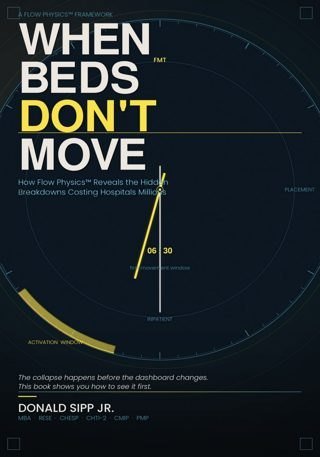
Front cover of When Beds Don't Move by Donald Sipp Jr.
The Book

A clear explanation of why capacity efforts stall when the underlying flow system stays misaligned.

The Program

Speaking, leadership sessions, and operational training built around the Flow Physics™ framework.

The Audience

Hospital executives, patient flow leaders, and support-service teams responsible for throughput.

The problem

The problem is not capacity. It is timing.

Hospital flow does not break in the ED, the PACU, or on the inpatient units. It breaks upstream, in seven operational engines running on different timing assumptions.

01

Linen drifts. Engine 0 misses its window, so readiness is compromised before most leaders arrive.

02

EVS starts late. The First Room Rule™ fails, and the morning hands off pressure instead of momentum.

03

Transport & placement inherit a stacked queue. The ED and inpatient units absorb what upstream engines failed to prevent.

Source-backed benchmark: the Executive Brief cites approximately $4.9M in annually recoverable revenue from a 1-hour ED boarding reduction (attributed to Pines et al., 2011).
Seven connected engines, one system

The seven-engine flow sequence

Each engine must hit its window so the next can activate without inheriting drift. Engine 6 is the final absorber — pressure not resolved upstream lands there.

Engine 0

Linen Flow

Engine 1

EVS

Engine 2

Transport

Engine 3

Placement

Engine 4

ED Flow

Engine 5

PACU

Engine 6 · Final absorber

Inpatient Units

Targets from the companion materials include FMT™ by 7:00 AM and Linen Flow™ ready by 6:30 AM, so PACU and ED pressure never cascade.

The big idea

Flow Physics™: diagnose and stabilize hospital flow

A proprietary operating system built from direct work inside hospitals — centered on leading indicators, protected windows, and visible ownership before the day turns reactive.

Measure 01

First Movement Time™

The timestamp of the first confirmed patient movement of the day. The single most predictive metric for how the day will go.

Measure 02

Stagnation Gap™

The daily minutes lost when the system stalls between engines, compounding into visible downstream pressure.

Measure 03

Activation Window™

The protected window each engine must hit so the next activates without inheriting drift, delay, or stacked work.

Inside the framework

The models behind the book

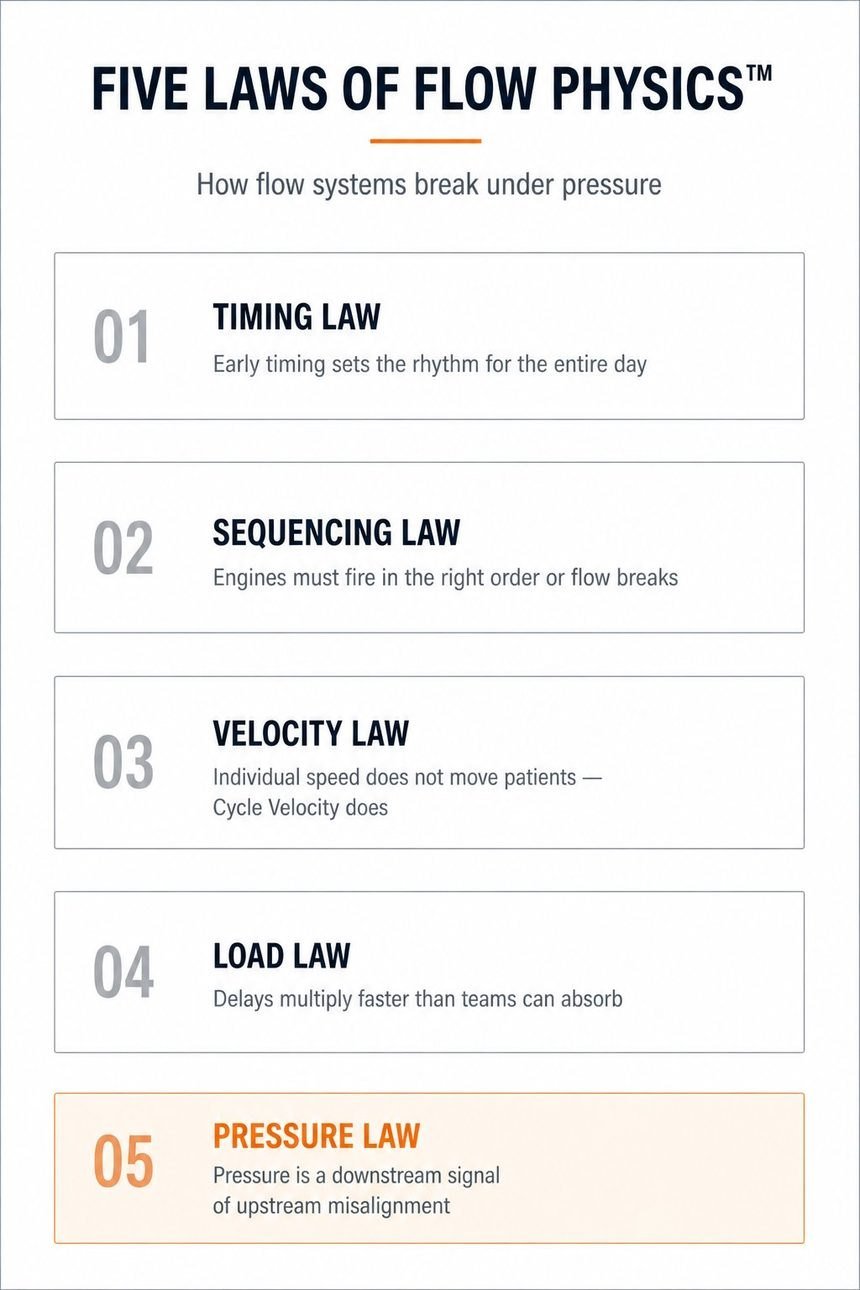
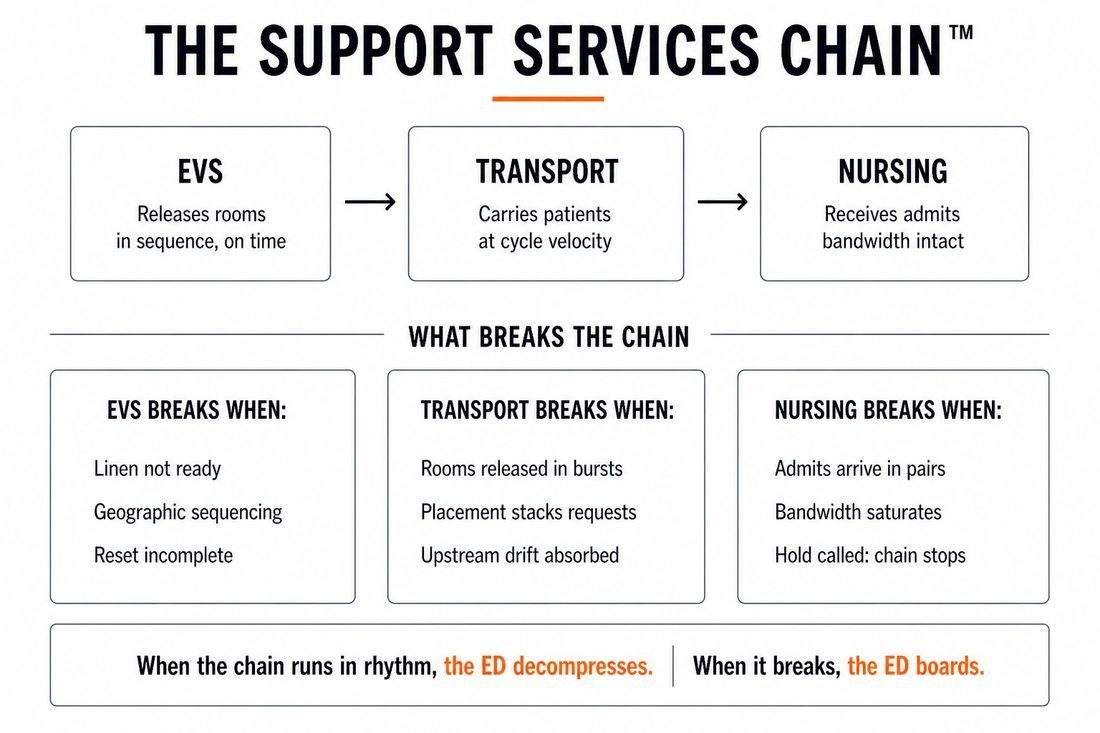
How flow systems break under pressure, and how the support-services chain holds them together.

The Five Laws of Flow PhysicsThe Five Laws of Flow Physics™ — how flow systems break under pressure.
The Support Services ChainThe Support Services Chain™ — EVS → Transport → Nursing. In rhythm, the ED decompresses.
Who it is for

Written for the people accountable for flow

COOs & hospital executives

You answer for capacity, length of stay, and boarding, and you need a system view that holds.

VPs & directors of operations / patient flow

Capacity, throughput, and care-progression leaders ready to move past point fixes.

Command center & throughput leaders

You want one connected model of flow instead of a wall of disconnected unit metrics.

EVS, transport & support-services leaders

You know your work drives flow. This gives you the framework to prove it and lead from it.

What you will take away

What leaders can do with the framework

Name and protect First Movement Time™, the leading indicator that predicts whether the day aligns or escalates.

Define Activation Windows™ for every engine, starting with Linen Flow™ and EVS where the morning is won or lost.

Run a Daily Flow Huddle, a 15-minute cadence that turns ownership on paper into visible action.

Make drift visible with a Quick Flow Scorecard, so Red/Yellow/Green can be seen before collapse.

Translate drift into financial exposure, including boarding loss, idle capacity, and protectable morning throughput.

Donald Sipp Jr.
About the author

Donald Sipp Jr.

MBA · RESE · CHESP · CHTI-2 · CMIP · PMP

Creator of the Flow Physics™ framework, Senior Director at Ruck-Shockey Associates, and Founder of Impact Training Company. His work focuses on the operational engines that decide whether patient flow stabilizes or stalls before the day fully begins.

His companion materials build around First Movement Time™, Activation Windows™, ownership alignment, and a practical morning operating cadence for hospital leaders and frontline support teams.

About Donald Sipp Jr. →
What the materials quantify

The operational and financial case

Executive Brief metric

First Movement Time™ shifted from 7:54 AM to 6:47 AM in the composite case, with PACU holds reduced from 6.2 to 1.8 per week.

Composite case illustration from the Executive Brief.
Financial exposure

A 1-hour reduction in ED boarding is cited as ~$4.9M in annually recoverable revenue; a 67-minute FMT™ shift is used as a composite ~$1.5M capacity-recovery projection.

Executive Brief citing Pines et al., 2011, plus composite assumptions.
The companion suite

Go from reading to doing

The book is the foundation. These companions help you put Flow Physics™ to work.

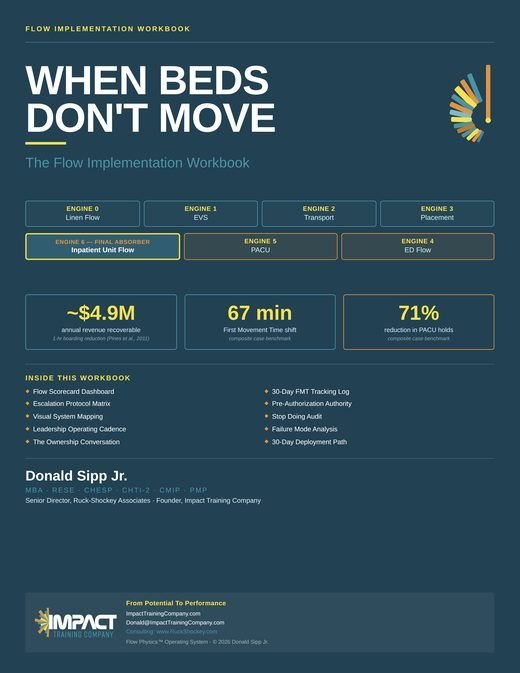
Flow Implementation Workbook
Hands-on

Flow Implementation Workbook

Engine sections, tracking logs, escalation protocols, scorecards, deployment path, and a financial model. ISBN 979-8-9960313-2-0.

EXECUTIVE BRIEF
cover
For leaders

Executive Brief

A concise leadership version focused on timing architecture, financial exposure, and the decisions that change the morning.

QUICK START
cover
First step

Flow Execution Quick Start

Four highest-leverage tools: First Movement Time™, Engine 0 & 1 activation, the Daily Flow Huddle, and the Quick Flow Scorecard.

Advance praise

What readers are saying

His ability to connect operational efficiency with patient outcomes is what sets him apart.
Antoinette “Toni” Watkins, MS, RDNSystem Director, Food, Nutrition & EVS, Riverside Health System
When Beds Don’t Move provides a practical, cut-to-the-chase approach to improving healthcare workflow. I applied one of the book’s frameworks, “Assign Defined Activation Windows,” to my own time management, and it worked.
L’Trentis SmithLicensed Nurse and Clinical Instructor
Get the details

Get the Executive Brief & launch updates

One email gets you the Executive Brief now, plus the book, Workbook, and Quick Start details at launch.

Send me the Flow Physics™ details

We'll send the Executive Brief and notify you on launch day, August 3, 2026.

Stop fixing departments. Start fixing flow.

Protect the morning, name the owner, and stabilize the seven-engine system.

Get the Executive Brief
Questions

Frequently asked questions

What is First Movement Time™?

The timestamp of the first confirmed patient movement of the operational day — described in the materials as the single most predictive operational metric in hospital flow.

What are the seven engines?

Linen Flow™, EVS, Transport Flow, Placement Flow, ED Flow, PACU Flow, and Inpatient Unit Flow.

Why do Engine 0 and Engine 1 matter so much?

The Quick Start identifies Linen Flow™ and EVS as the highest-leverage entry point — protecting those two Activation Windows™ often improves the morning fastest.

Is this only for hospitals?

The materials are written specifically for hospital patient flow and the morning timing architecture affecting ED, PACU, placement, transport, and inpatient units.

How do leaders start?

Name an FMT™ target, define Engine 0 and Engine 1 Activation Windows™, launch a Daily Flow Huddle, and use a Quick Flow Scorecard.