
Ask any bed manager about the hardest part of the day and you will often hear the same answer: the afternoon. Admissions from the emergency department and the operating rooms pile up after lunch, while many of the patients who are ready to go home are still waiting for their final paperwork, a ride, or a transporter. When discharges cluster late in the day, beds open late, and the patients who need them wait.
Patient transport sits right in the middle of this problem. A discharge is not finished until the patient has actually left the unit, and the room cannot be cleaned and turned over until that happens. This article looks at why discharge timing matters and what transport leaders can do to help their hospital move discharges earlier in the day.
Why Discharge Timing Matters for Hospital Flow
Hospitals have explored this idea for years. In one published improvement project at an urban academic medical center, two inpatient medical units set a goal of discharging more patients before noon. According to the study in the Journal of Hospital Medicine, the share of discharges before noon increased from 11% during the baseline period to an average of 38% over the 13-month intervention. The same study reported that the observed-to-expected length of stay declined from 1.06 to 0.96.
The project relied on things like afternoon interdisciplinary rounds to identify the next day's discharges, a shared checklist of daily responsibilities, and daily feedback on results. Transport was not the focus of that study, and every hospital is different. But the lesson carries over: when discharges are planned the day before and every department knows its part, more patients can leave earlier.
Where Transport Fits in the Discharge Process
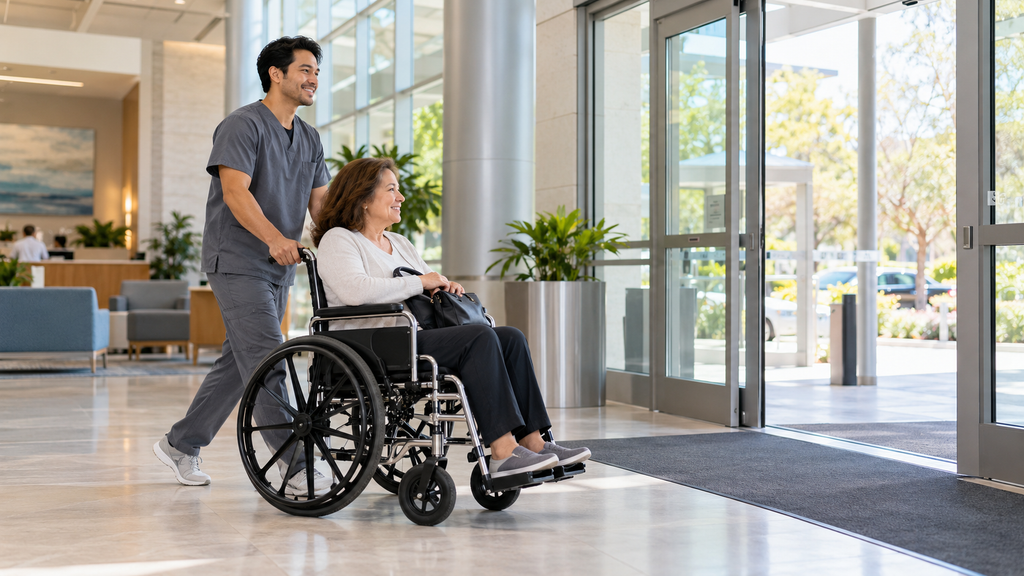
From the transport side, a discharge usually looks simple. A request comes in, a transporter goes to the unit, and the patient leaves by wheelchair or stretcher. In practice, a lot can slow that trip down:
- The request arrives before the patient is truly ready, so the transporter waits on the unit.
- Several discharge requests arrive at once, often right after rounds or late in the afternoon.
- The patient's ride is not at the entrance yet, so the transporter waits again at the door.
- Belongings, medications, or paperwork are still being gathered when the transporter arrives.
Each of these delays ties up a transporter who could be moving another patient.
Plan for Tomorrow's Discharges Today
The best way to move discharges earlier is to know about them sooner. Many hospitals already hold a daily bed meeting or discharge huddle. If transport is not part of that conversation, ask to join it, even for a few minutes.
Useful information to collect the day before includes:
- How many discharges each unit expects the next morning.
- Which patients will need a wheelchair, stretcher, or extra help.
- Which patients are waiting on a family ride or outside transportation.
- Any patients who need special handling under your facility's policies.
With that list, a transport supervisor can plan morning coverage instead of reacting to an afternoon surge.
Staff the Morning, Not Just the Afternoon
If your hospital is working to discharge earlier, your transport schedule needs to move with it. A team that is staffed for afternoon demand will struggle if discharge requests start arriving at 10 a.m.
Look at your own request data by hour of day. If discharge requests are starting to shift earlier, consider:
- Moving one or two start times earlier so more transporters are on the floor during the late morning.
- Scheduling breaks outside the window when discharge requests peak.
- Assigning a transporter to discharges during the busiest hour so those trips do not compete with urgent requests.
Make one change at a time and watch how long patients wait after a discharge request is placed. That number tells you whether the change helped.
Agree on What Ready to Go Means
One of the most common sources of wasted time is a discharge request that arrives before the patient can actually leave. Work with nursing leaders on a shared definition of when a patient is ready for transport. For example, the order is written, teaching is complete, belongings are packed, and the ride is on the way or confirmed.
When everyone uses the same definition, transporters arrive to patients who are ready, and nurses get help when they need it. Clinical decisions about readiness always belong to the care team and should follow your facility's policy. Transport's role is to be ready the moment the patient is.
Consistent training helps here too. Transporters who hold the Certified Healthcare Transporter (CHT) credential share a common standard for communication and handoffs, so a short, clear check with the nurse at pickup becomes routine instead of guesswork.
Track a Few Simple Measures
You do not need a complex dashboard to see whether discharges are moving earlier. Start with a few measures most dispatch systems already capture:
- The number of discharge transports completed before noon each day.
- The average time from discharge request to pickup.
- How often transporters arrive and the patient is not ready.
Share these numbers with nursing and bed management on a regular basis. When everyone can see the same data, it is much easier to agree on the next fix. The book When Beds Don't Move explores how support services like transport and EVS shape patient flow, and it is a helpful shared read for teams working on discharge timing together.
Build the Skills That Keep the Change Going
Earlier discharges are not a one-time project. Teams that keep their gains usually have supervisors and trainers who can teach the process and coach new hires.
Departments that want to build that teaching capacity in-house can prepare their own trainers through the Certified Healthcare Transporter Instructor (CHTI) program. When the people who know the floor are also the people teaching it, good discharge habits are much more likely to last.
A Practical First Step
If you want to help your hospital discharge patients earlier, start small. Ask to join tomorrow's discharge huddle, get a count of expected morning discharges by unit, and adjust one transporter's start time to match. Then track how many discharge transports finish before noon over the next few weeks.
Every patient who leaves on time opens a bed for someone who is waiting. That is one of the most direct ways a transport team can help the whole hospital move.
Sources
- Wertheimer B, et al. "Discharge Before Noon: An Achievable Hospital Goal." Journal of Hospital Medicine, 2014: https://cdn.mdedge.com/files/s3fs-public/pdfs/journals/jhm2154.pdf